
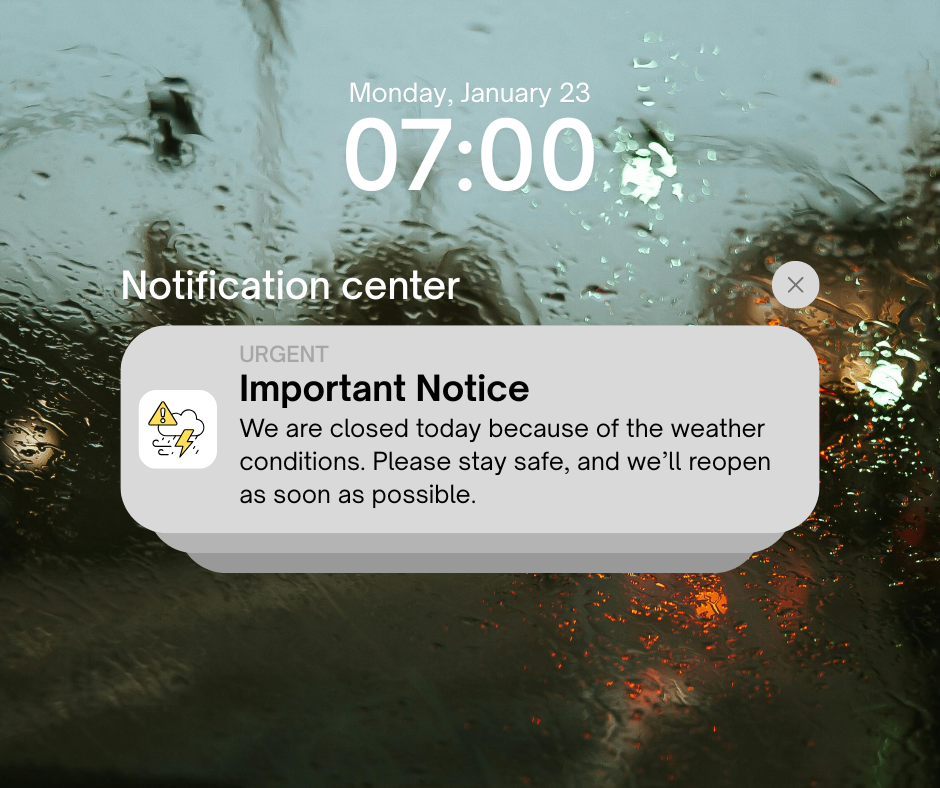
Weather-related school delays and cancellations directly impact student safety, learning time and family schedules. In Indiana, where winter weather can be unpredictable, school administrators must make early-morning decisions based on incomplete information while prioritizing student well-being. So how do Kokomo School Corporation officials determine two-hour delays, cancellations and e-learning days.
Weather Factors Considered in School Delays
The primary factors influencing school delays and cancellations include temperature, wind chill, road conditions and precipitation type. According to KSC superintendent Michael Sargent, temperature is often the most straightforward variable. The district relies on guidance from the National Weather Service, particularly frostbite risk charts, to evaluate student safety.
“So the National Weather Service provides a frostbite chart that we go by… anything within 30 minutes or more that has the potential to result in frostbite, we consider it a delay or sometimes we’ve done cancellations for that too;” he said.
Wind chill is especially important for students who wait at bus stops or walk to school. Because buses begin their routes as early as 6:30 a.m., administrators must make decisions well before sunrise, often without knowing how conditions may improve later in the morning.
Road Conditions and Transportation Challenges
Road safety is another critical component of the decision-making process. Snow and ice are evaluated differently, with ice presenting the greatest challenge.
“Ice is always the most challenging because it’s harder to drive on… snow can be a little different,” Sargent said.
Kokomo’s location within city boundaries plays a role in these decisions. The city’s snow removal efforts reduce some risks, but open areas and roads near fields can still create hazardous conditions due to wind and drifting snow.
To assess conditions accurately, administrators physically inspect roads.
“There’s two or three of us that drive to different areas throughout Kokomo and get a feel for what the current conditions are,” Sargent explained.
These assessments are particularly important for high school drivers and bus transportation, as the district operates a three-tier bus system that can be delayed when roads are slick.
Timing and Operational Considerations
Timing significantly affects whether school can operate safely. Overnight snow that stops early in the morning may still require buses to run on slick roads. Additionally, maintenance staff must be able to clear sidewalks and parking lots before students arrive.
“Timing does matter. If it comes in too early in the morning and we know it’s going to be sustained snow, it could create some complications,” he said.
Early release days are rare because road conditions typically improve during daylight hours as plows operate and sunlight warms the pavement.
Consistency, Delays and Learning Time
While there is no formal limit on the number of two-hour delays a district can use, consistency is a priority.
“There’s no limitation that I’m aware of for delays, but we try to be as consistent with school times as possible,” Sargent said.
Delays still result in lost instructional time, which motivates administrators to avoid them when possible. However, safety remains the top priority.
Use of Weather Data and Professional Judgment
Administrators rely on multiple weather sources rather than a single app. Forecasts provide estimates, but final decisions depend on real-time observations and collaboration with maintenance staff.
“It’s a prediction until the event happens,” he said. “Many times you really have to drive the roads.”
Only after gathering input from multiple sources does the district decide whether to proceed with a normal day, delay, cancellation or e-learning.
Cancellation vs. E-learning Decisions
The choice between canceling school and implementing e-learning depends on road safety and state regulations. Indiana allows districts to use only three e-learning days per year.
“If with the road conditions we don’t feel as if it’s safe to conduct school, we can move to e-learning, but the state only allows us to have three of those,” Sargent said.
Delays are typically used when administrators believe there is a strong chance school can still be held safely. In contrast, e-learning or cancellations are reserved for more severe or prolonged conditions.
Decisions about two-hour delays, cancellations and e-learning days involve careful consideration of weather data, road conditions, transportation logistics and instructional requirements. As Sargent emphasized, the ultimate goal is always student safety while maintaining as much consistency and learning time as possible.
“We have to take all the different components into consideration and try to make the best decision we can,” Sargent said.
This complex process highlights the balance administrators must strike between safety, education and the practical realities of operating a school district during unpredictable weather.